
Between Calls Issue #7
I did the reading. Here's what matters.

Welcome back. This issue, three things caught my eye: the Vatican’s “own” AI that turns out to be a Catholic startup, Midjourney pivoting from generating images to scanning your body, and a month where Anthropic argued for a pause, shipped its strongest model, and got switched off by the government anyway. Plus what I’ve been working on with the voice-agent workshops, and a short list worth a click.
What caught my eye
The Vatican’s “own” AI
A couple of weeks ago, I saw a social media interview with someone claiming to work at the Vatican on the Vatican’s own secure, local large language models. I thought it was interesting that the Vatican would run its own AI, especially right after the narrative of the Church coming out and condemning AI in general. I figured there was more to it, so I did a little research.
The first thing I found is that it isn’t really the Vatican itself. It’s Magisterium AI, built by a Catholic tech firm called Longbeard. What caught me is that the model is trained on more than 26,000 magisterial documents, plus another 5,000 or so scholarly works from people like Aquinas and Augustine, and it doesn’t touch the open web at all. It only answers from the sources it’s grounded in, and every answer comes with citations you can check.
The Vatican’s actual role is the part I keep thinking about. They’re digitizing their library, including manuscripts that previously meant traveling to Rome to read, and each institution gets to choose whether its texts stay public or private. So they essentially opened up their archive to feed this thing, on their own terms.
The model is also good with Latin, which is the detail I find most interesting. There’s a translation layer built in to auto-translate Latin documents, and Latin is not easy, even for an AI. It can get a lot wrong. I took Latin in high school, and I barely passed Latin 1 and Latin 2 with a C, because it was that hard.
To me this is a clean example of AI opening up access to what was effectively a dead language, something the general public never had unless they spent years learning it. Doing that with theological accuracy, and without a multi-billion-dollar data center, is genuinely impressive.
What it really said to me is simpler than the technology. Even the people who are anti-AI are using AI. The need is there. We’re going to keep finding pockets of real value, and that’s what keeps adoption climbing.
National Catholic Register on the Vatican AI digitization effort and Magisterium AI on its language coverage.
Midjourney moves into healthcare
I’ve been following Midjourney for a while, and I think they’re a genuinely interesting company, mostly because they were one of the first to ship really good digital art tooling. That stood out to me because ChatGPT and Google felt focused on the models but not the tooling around them. Midjourney clearly set itself apart there.
They recently announced they’re building a full-body scanner, which is a strange turn for a company known for generative images and media. They’re claiming a whole-body ultrasound that takes 60 seconds and gives you the same quality as a full-body MRI at about 100 times the speed. The pitch is cheaper, faster, and over time more accurate.
What’s interesting to me is that I’ve written recently about the rising need for radiology consultants over the last five years. When I think about AI job displacement, I can’t help but wonder who’s going to read these results. Will there be insurance-approved clinicians trained to read them? Do the outputs even look like an MRI? I know what the company is saying today, but it feels like there’s a lot left to be desired when you think about how this actually comes together.
I want to be fair about where this actually is, too. The 60-second scan is a headline, not a shipped product. The prototype was 20 minutes on 12 people, with no FDA clearance, and Midjourney has never shipped hardware or run a medical device before. Radiologists are also flagging the incidentaloma problem, where scanning healthy people surfaces findings that lead to unnecessary, sometimes risky follow-ups. So I’m holding the excitement and the skepticism at the same time.
I also think the general public has a massive appetite for proactive scans. The medical field and insurance companies usually tell us not to, because of false positives. But when I look at how the very wealthy operate, they’re getting MRIs done proactively, on a cadence, paying out of pocket. That’s why you see companies like Ways2Well and Function Health popping up, where people spend their own money on preventative care, because they know that catching something early can raise your survival odds dramatically.
What this really speaks to is demand. Midjourney is putting an enormous amount of money behind it, around 74 million of its own, to open spa-like places where people can get these scans. When I think about how AI is changing the way we live, the healthcare side is what excites me the most, by far.
If this gets FDA clearance and turns out to be reliable, even if it doesn’t replace an MRI but augments one, say it lands within 80% of the accuracy, and you can get it done for $50 in 60 seconds, why wouldn’t you? My other thought is that this is just the tip of the iceberg, whether it’s drug discovery, body scans, or new ways to measure things we couldn’t before. I think it’s an important next step in how we use AI.
My last point is the tone. When I think about how the public views AI, I want to stay positive here, because this is the kind of thing that could make a real difference in the world.
Midjourney’s healthcare announcement and Radiology Business on the $74M whole-body ultrasound bet.
When the labs hit the brakes and the government grabbed the wheel
One thing we’ve watched tech companies do for years: they reach a certain scale, whether in social media, search, ads, or data, and then they start pushing to self-regulate alongside the government. They frame it as safety. In practice they’re trying to keep competitors from catching up.
I haven’t seen a company contradict itself as hard as Anthropic has this past month. In a single stretch they argued publicly for a pause, then shipped the most capable model they had, right after spending months telling the government and the public to be afraid of it. When the government restricted that model because someone got in their ear, Anthropic came out publicly and said it was the wrong call and argued against it. It makes you wonder whether the government would have shut Mythos down at all if Anthropic hadn’t spent months priming everyone to fear it.
This wasn’t a two-day outage. The models went dark on June 12, and Mythos only came back on June 27, cleared to a small group of roughly 100 companies and agencies, with Fable reportedly close behind. The most concerning part is what it proved: the government has a lever it can pull to shut down these labs and their models.
That tells me a few things:
This won’t be the last time these models get restricted.
Without clear rules on how models ship, this keeps happening.
Nobody actually knows who’s in charge.
This isn’t a story about regulation being good or bad. We’re watching a control war. The government wants control but doesn’t know what control it wants. The largest labs say there should be control, but not on themselves, only on everyone else. This isn’t unique to Anthropic, every large lab is playing some version of the same game, but it’s more aggressive now because of where we are in this frontier AI shift. And because the United States is so far ahead, we’re front and center for all of it.
Fortune on Commerce clearing Mythos 5 and Anthropic on the Fable and Mythos access restrictions.
What I’m working on
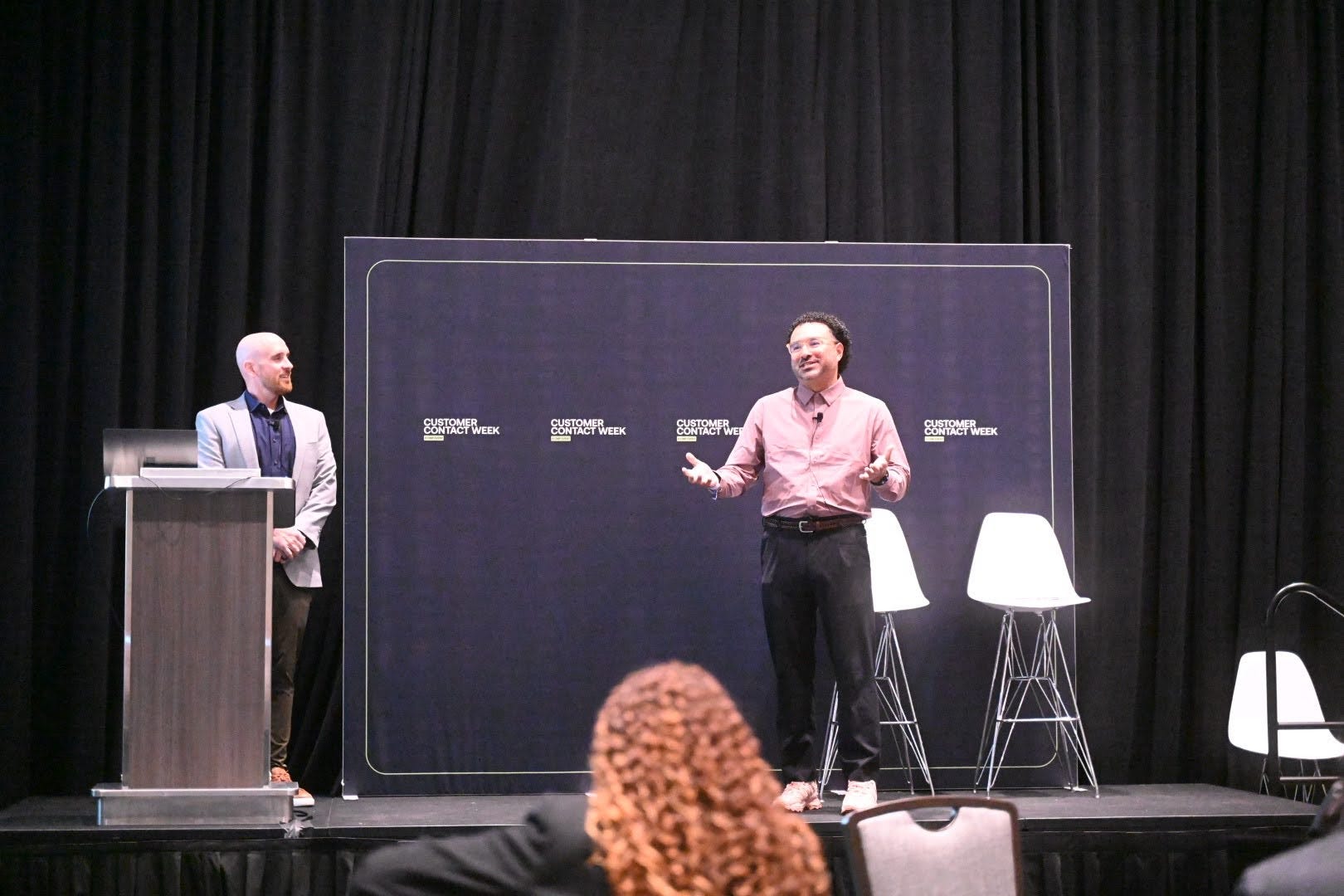
Early last year I brought an idea to my partner Daniel Pacheco: set up a workshop where we could get 150 to 200 customers in a room at once and walk them through building their own voice agents, fast. The context that matters here is that Daniel and I both came up with strong contact-center backgrounds. We used to go in and build IVRs ourselves, and we did it for years. Today it’s incredibly easy given where the technology is. Because of that, a lot of customers and individuals don’t have a firm grasp of what they can actually build, or how fast. You can stand up a voice agent in five minutes if you want to. Production-ready for a few use cases, maybe, not for everything, but that gap between what people think is possible and what actually is was the whole thing we wanted to get across.
So we spent the last six or seven months going to six different cities, helping people see how easy it is to build voice AI agents for IVRs. The seventh city was Las Vegas, at Customer Contact Week, where Daniel and I walked 150-plus people through building out AI voice agents in about 30 minutes. It was lightning fast, and it was a lot of fun. Daniel is one of the best demo engineers I’ve ever seen, and he did a fantastic job. I really enjoyed getting to travel city to city with him putting these on, and I can’t wait for what we do next.
The short list
California launches the first state dashboard tracking AI’s impact on jobs in real time. Newsom’s office, UCLA’s Policy Lab, and the state EDD tied each occupation’s AI exposure to monthly unemployment claims. No statewide rise yet, but claims from college-educated workers in high-exposure jobs climbed after ChatGPT-3.5, and high-exposure Bay Area workers saw a sustained increase.
DOE conditionally commits $17.5B to jumpstart 10 big nuclear reactors. The federal balance sheet steps in behind AI’s power problem: conditional loans for long-lead equipment on up to 10 Westinghouse AP1000 reactors, which Secretary Wright said could speed deployment by up to three years.
New York passes a companion-chatbot safety ban for minors, at $25K per violation. The states keep getting concrete on AI harms that touch kids, even as a federal draft floats freezing new state AI laws for three years.
A startup moves 100% off Claude to open-weight DeepSeek “to survive”. Cost pressure is pushing companies toward open-weight models, and Lindy says the switch saved it millions.
If this was useful, share it with someone who’d find it worth the read.
Only proofread with AI, never writtenDraft placeholder. Formatted body pasted via Chrome.