
Between Calls Issue #4
What this week's earnings, the Uber playbook, and a Stanford neuroscientist all keep pointing at.

What caught my eye
The free first ride became the free token
When Lyft came out years ago, I remember I was living in Tulsa, Oklahoma, and I downloaded the app because I hated taxis. They gave me 75 free rides. To use within 90 days for up to $20 a ride. Really, because Tulsa’s small, I only had to pay for the tip, and I remember how cool that was. There were times I would just leave for a friend’s house because it was cheaper than driving, because I didn’t have to pay for gas. A few months later they gave me more free rides, and we used it non-stop all the time. When those free rides went away, it was really cheap, so we still used it all the time. It was really easy to get from restaurants to other friends’ houses to bars.
Looking at how I’m using different AI tools today between Co-pilot, Claude, ChatGPT, and Gemini, I’m paying for three of those. I look at the value I get out of those on a day-to-day basis, and it’s worth every dollar, and especially Claude. I look at how much I’m actually using, and it really makes me think that I have a flat fee that’s pretty much all you can eat within reason. There are limits, but they’re very high limits on my plan. I think to myself that if I extrapolate that usage to what’s being charged, you say an API call if you were to hit Opus 4.7 directly. And it’s night and day. It would be so much more money, and all I can think of is these lift rides: how often I was using it, the value I got out of it.
It really looks like these AI companies are using a very similar playbook. Uber, for example, from 2018 to 2021, their rates climbed 92%. They didn’t post their first annual profit until 2023. From 2018 to 2022 they were unprofitable, but they slowly turn up the meters to ensure that people were not in a place where they will not adopt the technology. Uber had a marginal cost per ride that was zero. The drivers paid for gas, vehicle, insurance, but these AI labs pay real GPU cost with every token. While OpenAI had a 33% gross margin in 2025, its inference cost was about 8.4 billion, and they project it will rise to about 14.1 billion in 2026.
This doesn’t get said very often that I’ve seen, but they’re clearly spending this inference cost and taking the hit because they’re running a really similar playbook to what Uber and Lyft did back in 2020. The first ride became the free token, and then tokenized billing is going to be a recoup phase when it’s no longer a flat fee, all-you-can-eat buffet style of using this technology for everyone using it. Why I’m thinking about this now is that, because drivers absorb the fee, Uber knew that they could do this for years if they had to. These AI labs don’t have that ability.
I think over the next two to three years, you’re really going to see usage limits start to get enforced heavier and heavier as people start adopting this technology. By then we’re already going to rely on it, and then you’re just going to see mass increases in revenue.
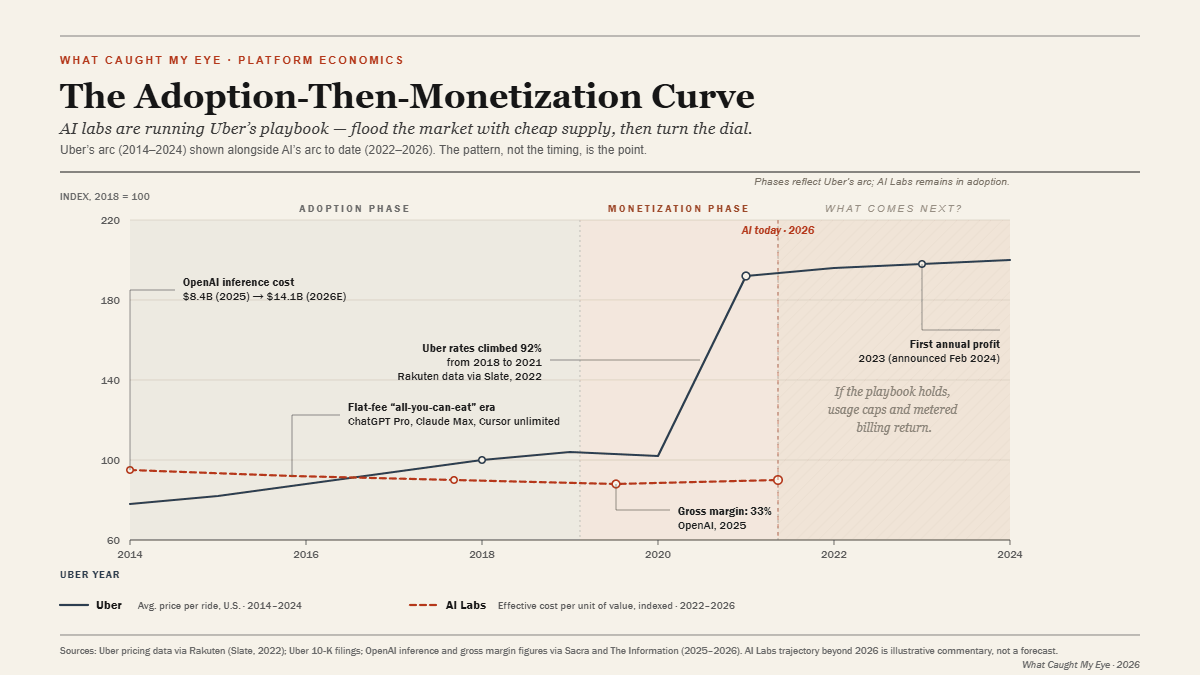
Slate on the Uber subsidy history and Sacra on OpenAI’s inference economics.
The hyperscaler capex week was an industrial buildout in software clothing
If you own any major index fund right now, last week was a massive week for the stock market. Amazon, Google, and Microsoft all reported earnings. I had a few takeaways from this:
All three of these companies’ CEOs basically said the same thing in different words: they can’t build fast enough to meet demand.
They reported hundreds of billions in contracted backlog. Microsoft’s RPO alone was $627 billion.
They’ve committed roughly $575 billion in capex between the three of them, basically the size of Sweden’s GDP.
For whatever reason, most of Wall Street is still applying software company logic to it. This is basically an industrial infrastructure buildout by all of these software companies.
The pattern that’s most interesting to me is that what’s being rewarded isn’t even who has the best AI. It’s whoever has the framing that they have the best infrastructure, and whoever’s communicating that most clearly. I think Google is the example of that.
The era that most resembles this to me was when telecom companies were building out fiber. They spent roughly $500 billion on fiber, and the vast majority of those players were gone within five years. That’s the historical playbook Wall Street seems to be running. The difference is that the fiber buildout was happening ahead of the demand. The demand just keeps increasing here, and I think anybody that’s in the middle of it, whether it’s sales, engineering, or product, can actually see that clearer than Wall Street can.
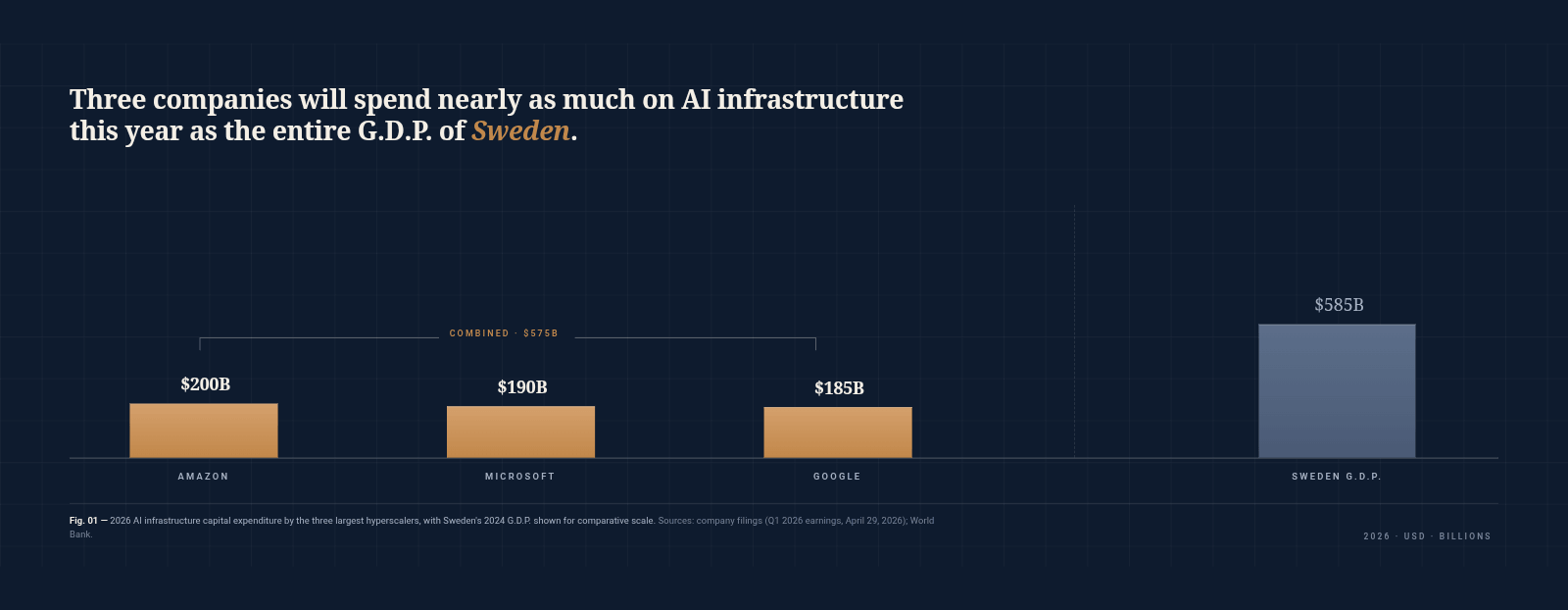
Tom Tunguz on the $112 billion quarter and CNBC on Microsoft’s Q3 earnings.
Motorcycles, not mimics, how to actually use AI
I listened to a really interesting podcast this last week. It was Eagleman on Diary of a CEO and they talked a lot about how AI works with people’s minds. My favorite comparison was when Eagleman called AI a motorcycle for the mind. He was building on Steve Jobs, who used to say the personal computer was a bicycle for the mind. I like the contrast. A bicycle makes you faster than walking. A motorcycle puts you in a different race.
I keep hearing the same type of narrative where people are trying to make AI come across as either really negative or really positive. I’m less interested in that debate. What I keep coming back to is how much better and smarter it can make you because of the power you just have in your pocket to use AI. Eagleman said something else that stuck with me. He said we all have Aristotle in our pocket now. Alexander the Great had one tutor. We have one too, available all day, never tired of our questions.
The part that really sharpened my thinking was when Eagleman talked about two kinds of friction. He calls them vicious friction and virtuous friction. Vicious friction is the busywork. The spreadsheets, the admin, the copy and paste stuff. Push all of that to AI. There’s no honor in it. Virtuous friction is the hard thinking. The strategy, the structure, the original ideas. If you outsource that part, you atrophy. So the question isn’t whether to use AI. The question is whether you know which side of the line you’re on every time you open the chat.
This is exactly why, as we all start building AI agents into our personal life, there’s a real mental framework we can apply to make sure these AI agents we’re deploying are not mimicking what we do but are really built to empower what we do day-to-day. The trap is using AI as a shortcut around the thinking. The win is using AI as a counter voice. Something that pushes back and shows you blind spots you would never find on your own. Eagleman does this himself. He brings a half-formed idea to the model and asks it to give him the counterarguments, tell him why he’s wrong, and find his blind spots. That’s not outsourcing. That’s compounding.
The motorcycle is in the garage. The question is whether you’re using it to go somewhere new, or just to avoid the walk.
Diary of a CEO with Dr. David Eagleman.
What Microsoft is up to
The platform underneath is the blocker
My team and I just got nominated for Automation Solution of the Year at Customer Contact Week in Las Vegas. We won’t find out until June if we win, but seeing the name on the list was the first time the work this year felt like it landed externally.
Most of what my team and I have been doing for the last twelve months is helping customers actually get value out of agentic AI. The thing nobody tells you upfront: the biggest blocker isn’t the AI. It’s the platform underneath it. A lot of these customers are sitting on a stack that was built before generative AI existed, and you can’t bolt agents onto that and expect speed.
The pattern that keeps surfacing: customers who pick a single platform that ships CRM, contact center, and telephony together hit value way faster than customers running three separate tools and stitching the data together. Microsoft is the only major player where all three are native. Competitors say they offer it; nobody else actually does.
That’s the case my team made to the CCW judges, and that’s why I think the work got the nod. The technology was always there. The framework for picking the right substrate is what was missing.
Customer Contact Week Excellence Awards.
What I’m testing
Rapid iteration
I’ve been working on optimizing how Cowork posts on social media for me when it comes to my coffee bean business. This is more of a learning. It was producing really poor content over and over, and we’ve worked on this for probably four weeks.
I spent some time going through this in an hour and a half. I realized that I wasn’t effectively testing what I was putting out. Instead, I would spend a lot of time creating really intense marketing rules and image generation rules to lay out the guidelines of what I wanted. Then I would let the schedule run, and I would see the media output, and it wasn’t what I wanted.
Because of this, I spent about 90 minutes just iterating on one thing at a time. I wanted it to generate an image within the guidelines I wanted, with the style I wanted. It would try, and it would be wrong. I would tell it why it was wrong. I went through probably four or five cycles of that. What it turned into is exactly what I wanted.
I realized that extending this for long periods of time was making me feel like the tool just couldn’t do what I wanted, but realistically it could. I just wasn’t giving it the right focus and the right cycles within the timeline I was expecting.
Moving forward, I’m going to create stricter guidelines for specific details or functions that I want, not just a good prompt for a schedule. I’m going to test the output fully and iterate on it before I say it’s done, so things move faster.


Same bag, two outputs. Left: a generic product shot the schedule kept producing. Right: what 90 minutes of focused iteration got me when I tested one thing at a time.
The short list
Google adds up to $40 billion to Anthropic. The three-hyperscaler stack got locked in within 96 hours.
China blocks Meta’s $2 billion Manus deal. First time Beijing has publicly stopped a foreign AI talent acquisition like this.
Meta signs a 1GW space-solar deal with Overview Energy. Commercial power expected in 2030.
Tim Cook steps down September 1, Ternus takes over Apple and Stratechery on the AI hole and China problem he inherits.
Bezos’s Project Prometheus closes $10 billion at a $38 billion valuation. Five months after launch, focus is physical AI rather than chatbots.
If this was useful, share it with someone who’d find it worth the read.
Only proofread with AI, never written